


Over the past year, the AI conversation has shifted dramatically. Technology leaders are no longer debating feasibility or experimenting at the edges. We've entered a new phase defined by AI-driven business outcomes. The real differentiator now is whether an enterprise can build the data foundation, execution engine, and cross-functional alignment required to turn AI from a promising concept into a durable competitive advantage.
This shift has expanded the CIO's mandate. AI strategy and revenue strategy are now one in the same, and the outcomes CEOs care about most – growth, customer experience, productivity, and cost efficiency – hinge on the quality of the revenue data that powers enterprise AI.
Against this backdrop, Clari + Salesloft Labs' latest research, “Predictable Revenue Starts in IT: Building the Foundation for AI-Ready GTM Data,” reveals a striking paradox: 87% of enterprises missed their number in 2025, despite record AI investment, showing that AI adoption alone doesn't drive results. The root cause becomes clear when paired with findings from our previous report: 67% of revenue leaders admit they don't trust their data, creating uncertainty at the exact moment companies need precision.
When AI runs on fragmented, stale, or conflicting inputs, it undermines decision-making across every revenue-critical workflow. But when powered by a unified, continuously improving revenue dataset, AI acts as a catalyst for predictable, scalable growth. This shift places CIOs at the center of modern revenue leadership.
AI for revenue meets real-world enterprise constraints
Worldwide AI spending is expected to surpass $2 trillion by 2026, and companies are quickly adopting Revenue AI to strengthen forecasts, accelerate sales cycles, and deepen their customer relationships. Yet the findings from our latest research reveal a stark disconnect between AI aspiration and readiness.
Despite unprecedented investment:
87% of enterprises still miss their revenue targetsOnly one-third of RevOps leaders fully trust their forecast data55% report conflicting pipeline signals across teams
AI is exposing the cracks in GTM data rather than fixing them. And for CIOs, this gap represents both a wake-up call and a generational leadership opportunity. Revenue teams want AI that is consistent and reliable. But, now more than ever, that requires the CIO and CRO to operate as co-owners of a unified revenue data foundation. Without that partnership, AI remains a promising idea instead of a performance engine.
Why enterprises still lack AI-ready data
For this research, Clari + Salesloft Labs surveyed 400 enterprise CIOs, CROs, RevOps, Sales, and IT leaders (none of whom are Clari or Salesloft customers). Their responses paint a clear picture of the structural issues slowing down AI adoption:
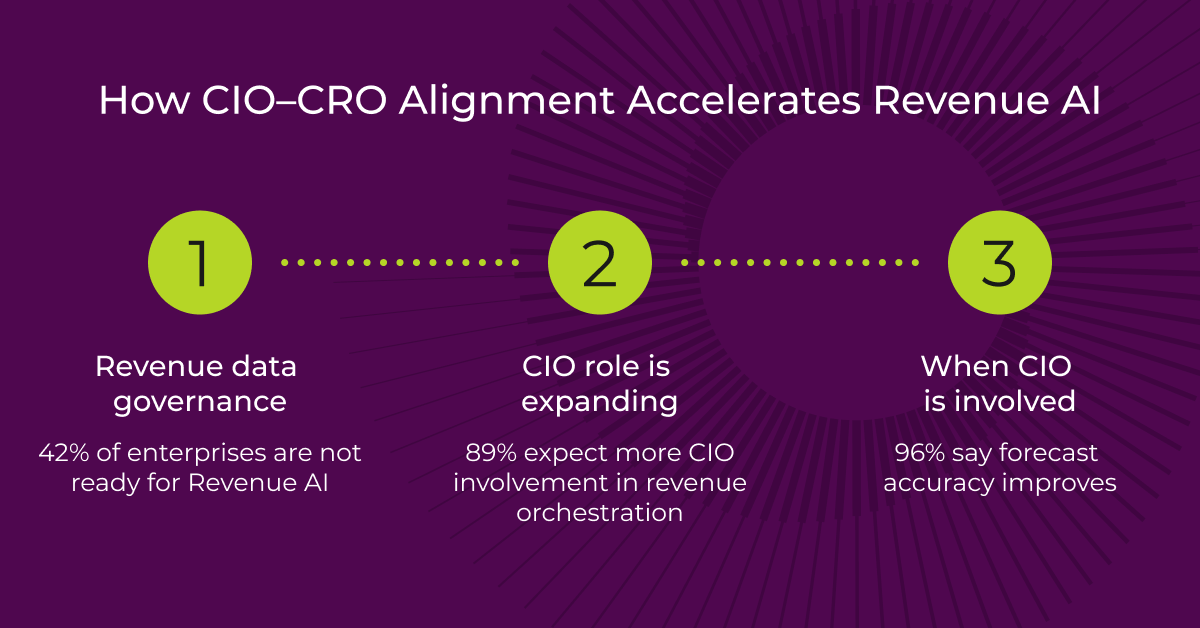
48% say their revenue data is not AI-ready42% lack formal governance frameworks for Revenue AIFewer than half of companies have automated even 50% of their revenue processes
When AI runs on fragmented, stale, or conflicting inputs, it undermines decision-making across every revenue-critical workflow. But when powered by a unified, continuously improving revenue dataset, AI acts as a catalyst for predictable, scalable growth, placing CIOs at the center of modern revenue leadership.
The structural gaps holding enterprises back
Tools like CRMs and conversation intelligence platforms generate valuable signals, but they address only part of the challenge. Revenue data remains fragmented across too many systems, modeled inconsistently, and disconnected from day-to-day execution. That fragmentation produces insight without operational impact.
Most revenue systems were never designed to support the precision, transparency, and governance that AI demands. Foundational barriers persist:
- Conflicting data sources
- Siloed revenue systems
- Weak or undefined governance
- Limited visibility into pipeline health and forecast inputs
This execution gap must be closed for any organization expecting AI to deliver durable competitive advantage.
What CIOs uniquely bring to the future of Revenue AI
CIOs already own the capabilities that determine whether an enterprise can successfully operationalize AI: architecture, integration, lineage, governance, security, and reliability. Now those capabilities must be applied directly to revenue.
Leading enterprises are shifting from tactical AI (email drafts, content suggestions) to strategic revenue infrastructure, including:
- AI-powered forecasting engines
- Unified revenue databases
- Pipeline risk intelligence
- Cross-functional orchestration frameworks
- Standardized revenue data definitions
- Secure, auditable governance systems
When CIOs lead this architecture, revenue signals become more accurate, more repeatable, and more strategically valuable. According to this new research, companies see up to 30% efficiency gains when CIOs lead GenAI transformation.
Governance and system reliability as growth engines
AI only works when revenue systems meet a higher standard of rigor: validated data, traceable lineage, auditable processes, and disciplined governance. Anything less limits AI's ability to drive sustainable growth.
CIOs bring the discipline and system-level thinking needed to embed these practices into everyday operations. Once trust in the data improves, teams move faster, forecasts tighten, and AI becomes a strategic partner rather than a source of noise.
The CIO–CRO partnership now defines revenue predictability
Alignment drives revenue transformation, and no relationship matters more than the partnership between CIOs and CROs. When these leaders work in lockstep, organizations gain the unified vision and operational rigor required to turn AI investments into measurable revenue outcomes. The data reveals just how critical this collaboration has become:
98% of enterprise leaders say CIO–CRO collaboration directly impacts revenue performanceYet 28% meet only monthly or quarterly, far too infrequently for real-time AI-driven revenue management96% agree that forecast accuracy improves when CIOs are directly involved89% expect the CIO's role in forecasting to increase over the next year
Data integrity becomes a competitive advantage in the AI era
AI only magnifies the realities of data quality. Organizations that prioritize data integrity unlock a fundamentally different outcome: more reliable forecasts, earlier risk visibility, evidence-based decisions, and seller guidance grounded in reality rather than guesswork.
As AI reshapes how revenue is generated, managed, and predicted, CIOs are stepping into a broader leadership role, influencing top-line planning, customer engagement, and forecast governance. By embracing this responsibility, they move their organizations from AI experimentation to execution, turning fragmented data into strategic clarity and enabling predictable, repeatable growth.
The path toward scalable, AI-driven revenue operations
The enterprises that win in the AI era will be the ones that build the strongest foundations. With the right architecture, CIOs can:
- Move Revenue AI out of pilots and into core operations
Shift AI from isolated experiments into always-on revenue workflows by embedding AI directly into forecasting, pipeline management, and execution cadences. The data shows organizations stall when AI is treated as a side project rather than production infrastructure.
. - Create a single, governed revenue data foundation
Standardize revenue data models, unify fragmented systems, and eliminate conflicting signals across sales, marketing, and finance. With 55% of enterprises reporting conflicting pipeline data and 42% lacking formal governance, CIO-led data unification is the fastest path to trust and accuracy.
. - Prioritize CIO–CRO ownership of revenue outcomes
Establish shared accountability with the CRO through frequent operating cadences, aligned metrics, and joint ownership of Revenue AI tool selection. Revenue organizations with CIOs directly involved see measurable gains in forecast accuracy and predictability quarter after quarter.
The question now is whether your organization has the data foundation to make that transformation to AI-powered revenue orchestration successful. CIOs who act decisively to build unified, governed revenue systems will define what competitive advantage looks like in an AI-first world.
Download “Predictable Revenue Starts in IT: Building the Foundation for AI-Ready GTM Data” to learn more